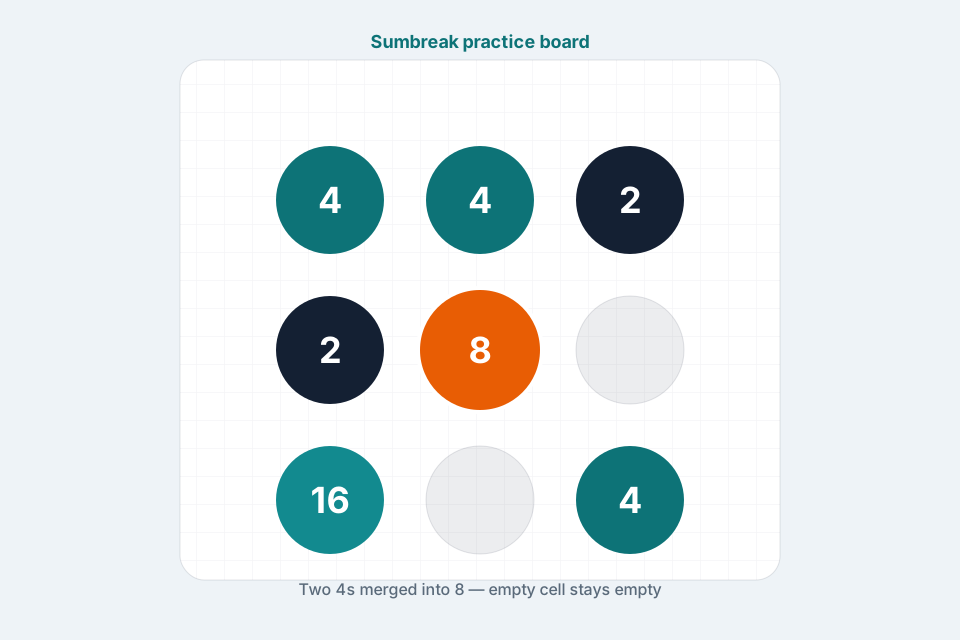
These Sumbreak tips come from how the merge rules actually behave on Sumbreak.online boards: identical orthogonal neighbors combine into their sum, diagonals never count, and empty cells stay empty. Use them on Daily and Practice—not as a claim about someone else’s private daily file.
Tip 1 — Start with the smallest forced pair
Early in a board, the smallest matching pair is often forced: only one legal place those two numbers can meet. Merge them first. That clears clutter and reveals which larger numbers now share an edge. Racing for the biggest tile first usually strands a lonely high value with no partner.
Tip 2 — Decide where the sum should land
Merging A onto B is not the same as merging B onto A. The sum always sits on the destination. Before you drag, ask: which square should hold the new number so it can meet its next partner? A one-tile mistake here creates an empty wall that splits the board.
Tip 3 — Treat empty cells as walls
Nothing slides. An empty square permanently separates the tiles on either side until later merges change adjacency. When you create a blank between two regions, you may permanently cut a number off from its only match. Prefer merges that keep the remaining numbers in one connected cluster.
Tip 4 — Build toward the largest tile
The highest number on the board usually needs a matching partner built beside it. Work chains that grow a twin next to that peak instead of merging away from it. Think of the large tile as an anchor: bring its match to its edge, then combine.
Tip 5 — Undo is part of good play
Sumbreak rewards foresight, but practice boards are for experimentation. If a merge feels wrong within one or two moves, Undo immediately. Burning three more merges trying to “save” a bad empty often locks the board. Reset is fine on Practice; on Daily, Undo plus Last good move preserve the same date seed.
Tip 6 — Use Hint to learn adjacency, not to autopilot
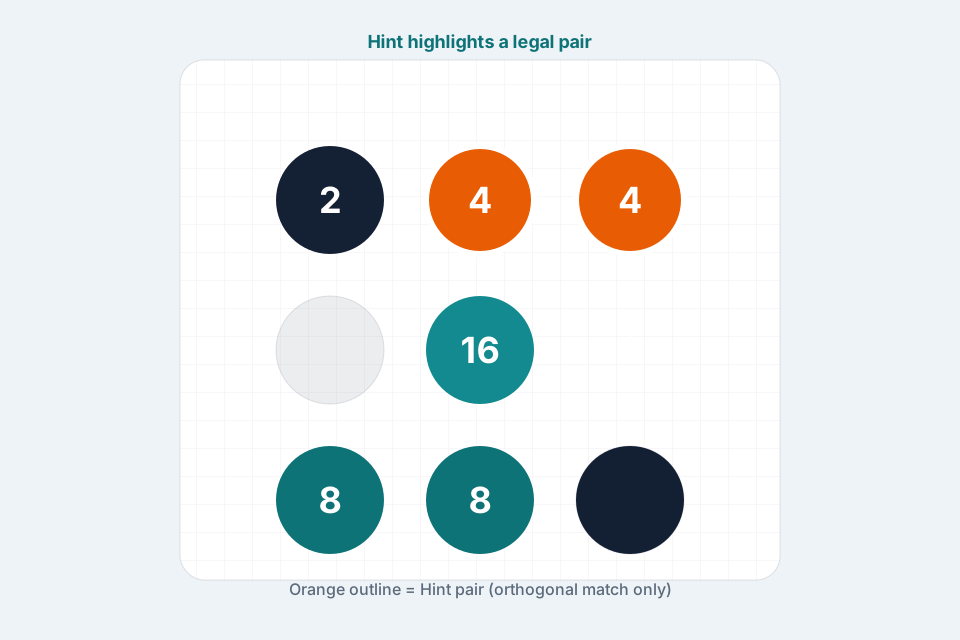
Hint outlines one legal pair. Use it when you are learning which neighbors count, or when you are blind to an obvious match. Do not spam Hint through an entire Daily if your goal is to improve—try a minute of scanning first, then Hint once, then explain to yourself why that pair was legal.
Tip 7 — Last good move beats random thrashing
When no merges remain, the board is dead. Last good move restores the position from just before the dead-end. That is faster than Reset if you only need to rewind the final mistake. If Last good move is unavailable, Undo as far as you can or Reset the mode.
Tip 8 — Practice mode for risky lines
Daily is one seed per local date. Practice generates another solvable board so you can try aggressive lines—sacrificing a region to free a twin for the peak—without waiting for tomorrow. Warm-up stays fixed for teaching muscle memory on tap-to-merge.
Tip 9 — Mobile: tap-tap is steadier than long drags
On phones, drag targets are easy to miss. Tap the first circle, confirm it is selected, then tap the matching neighbor. Use Fullscreen from the home toolbar when the ledger feels cramped.
Tip 10 — Know what this site is (and is not)
These tips describe this site’s free practice boards. They follow the public Sumbreak merge rules popularized by LinkedIn Games, but Sumbreak.online is independent and does not publish LinkedIn’s official daily spoilers. For unstuck help without spoilers, read Sumbreak hints. For the rulebook, see how to play Sumbreak. To play now, open the home page.
Quick checklist before each merge
- Same number?
- Sharing an edge (not a corner)?
- Where should the sum sit?
- Does the new empty split a future pair?
- If unsure, Undo is cheaper than a dead board.
Master those five questions and most Sumbreak boards stop feeling random.